A meter that matches the pipe diameter can still fail if its usable range, fluid properties, installation position, or pressure rating do not match the system. By the end, you will be able to calculate the duty, compare meter technologies, check installation conditions, and write a specification that protects measurement accuracy and equipment life.
Key takeaways
- Size the meter for minimum, normal, and maximum flow conditions.
- Match electromagnetic, ultrasonic, or mechanical measurement to water quality.
- Check straight-run length, pipe filling, valves, and installation access.
- Specify outputs, verification records, and water-accounting data before purchase.
Define the Flow Duty Before Choosing a Meter Size
Before selecting a meter, calculate the duty at minimum, normal, and maximum operating conditions. Industrial flow meter sizing based only on the largest design flow can produce poor readings when the process signal approaches the meter’s cutoff or noise floor. Record the actual operating envelope, not just the nominal pipe size.
- Flow: determine minimum and maximum flow, normal flow, expected start-up flow, and any intermittent peaks.
- Pipe: record nominal pipe size, internal diameter, schedule, lining, and whether the meter will be full-bore or reduced-bore.
- Pressure: calculate steady operating pressure and pressure spikes from pump starts, stops, rapid valve closure, or check-valve slam.
- Fluid: document temperature, conductivity, viscosity, solids, grit, fibers, sludge, and chemical compatibility with liners and electrodes.
- Performance: set the required accuracy at normal flow and at the lowest flow you must measure; rangeability alone does not guarantee accuracy across that span.
Estimate the flow before trusting a catalogue range.
| Method | Calculation | Best use |
|---|---|---|
| Pump capacity calculation | Use pump curve, discharge pressure, and operating point | Pressurized systems with a known pump |
| Tank volume | Flow = volume transferred ÷ elapsed time | Batch filling, draining, or level-tested lines |
| Pipe area and velocity | Flow = pipe cross-sectional area × measured velocity | Checking a proposed meter range against actual line conditions |
A meter matching the nominal pipe size can still be incorrectly sized if the process normally runs near its lower limit. Compare calculated flow with the meter’s specified accuracy range, then verify that pressure and temperature ratings cover operating conditions and transients.
Match the Measurement Principle to the Water
Choose the measurement principle from the water first, then test it against the accuracy target and pipe arrangement. Clean water and wastewater do not produce the same signal, and a meter that works on one can fail on the other.
| Option | Water condition | Accuracy and application | Pipe arrangement |
|---|---|---|---|
| Electromagnetic flow meter | Conductive water, including treated water, cooling return, and wastewater | Strong choice for accurate, bidirectional measurement with no moving parts | Keep the bore full; provide correct grounding or grounding rings in plastic-lined or electrically isolated pipe |
| Transit-time ultrasonic | Clean, homogeneous water with little suspended material or entrained air | Good choice for non-invasive measurement and clean-water accuracy | Clamp-on or inline installation is possible, but air pockets and poor sensor alignment cause signal loss |
| Doppler ultrasonic meter | Water containing suspended solids, grit, sludge, fibres, or gas bubbles | Useful where those reflectors are present; clean water can produce an unstable reading | Install where the pipe stays full and solids remain mixed, not in a settling section |
For wastewater and abrasive process water, specify liner and electrode materials alongside accuracy. Grit can wear a liner, while incompatible chemistry can attack electrodes; pipe size and flow range alone do not protect service life.
An electromagnetic flow meter can drift when electrodes coat, bonding is poor, grounding is inadequate, or the pipe runs partly full. Downhill runs, high points, open discharge, and insufficient backpressure create those conditions.
If the result supports formal water accounting, check OIML R 49 or the applicable ISO 4064 requirement and verification procedure. Catalogue accuracy does not make an industrial meter legal for trade.
Check Installation Conditions Before Approving the Meter
An elbow, pump, reducer, header, or partly closed valve immediately upstream can distort the velocity profile and shift the meter reading. Check the exact straight pipe length specified for the selected model; a common 5D upstream and 2D downstream rule is not universal, especially after out-of-plane elbows.
Add distance or a flow conditioner when the manufacturer requires it.
Full pipe measurement is essential for electromagnetic and many ultrasonic meters. A full-bore meter does not guarantee a full pipe: downhill runs, high points, open discharges, undersized downstream piping, and low backpressure can trap air or leave the sensing section partially filled. The result can be unstable, zero, or convincingly wrong flow.
Pressure rating must cover water hammer pressure, not only steady operating pressure. Pump starts, pump stops, rapid valve closure, and check-valve slam can damage the liner, sensor body, gasket, or flange.
Use this flow meter installation check before approval:
- Compare the proposed location with the model’s installation diagram and measure the available straight pipe length.
- Confirm that the pipe stays full at minimum flow, during shutdown, and after downstream changes.
- For an insertion meter, verify insertion depth, probe alignment, access clearance, and whether one point represents the pipe-average velocity; use a full-bore meter for billing or tight allocation accuracy.
- Check liner and electrode compatibility with grit, fibres, sludge, and chemicals, then specify grounding rings or electrodes for plastic-lined or electrically isolated pipe.
- Compare static and transient pressure, including the water hammer pressure recorded or calculated for pump and valve events.
Specify Outputs, Verification, and Water-Accounting Requirements
A catalogue figure for flow meter accuracy does not make the measurement acceptable for allocation or formal water accounting.
Require the applicable metering standard and acceptance method: OIML R 49 and the ISO 4064 family address water-meter performance, testing, and metrological requirements, while a process meter with a favorable specification is not automatically legal for trade.
Define the complete data chain, not just the sensor. A 4–20 mA output, pulse signal, HART value, or fieldbus reading can transmit a wrong measurement perfectly if the meter is mis-sized, partially full, poorly grounded, or configured with incorrect units.
Require these items in the purchase specification:
- Accuracy at minimum, normal, and maximum flow, expressed as percentage of reading or percentage of full scale
- Flow cutoff, minimum measurable flow, rangeability, and pulse or analogue output resolution
- Flow totalizer behavior during power loss, communication failure, restart, and reverse flow
- Alarm states, event logs, timestamps, time-zone handling, and protection against unauthorised configuration changes
- The calibration certificate, serial number, test points, traceability, and stated uncertainty
- The required in-situ verification method: calibrated reference meter, tank gravimetry, or certified prover
For billing, allocation, or a tight water balance, prefer a properly installed full-bore meter over an insertion meter; insertion depth, probe alignment, and local velocity distortion add uncertainty. Specify liner and electrode materials for grit, fibres, sludge, or chemical exposure.
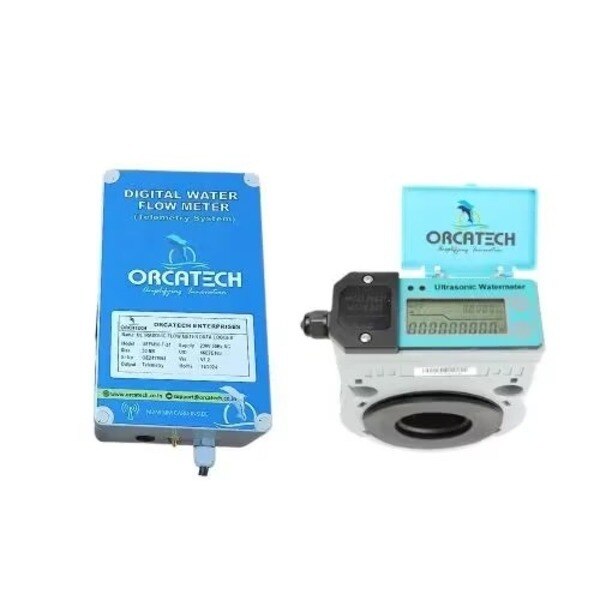
Orcatech Enterprises can help document telemetry and totalizer requirements so the transmitted data remains auditable rather than merely accessible.
Related products
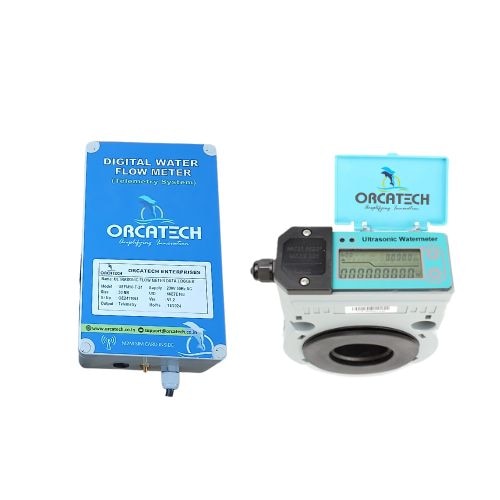
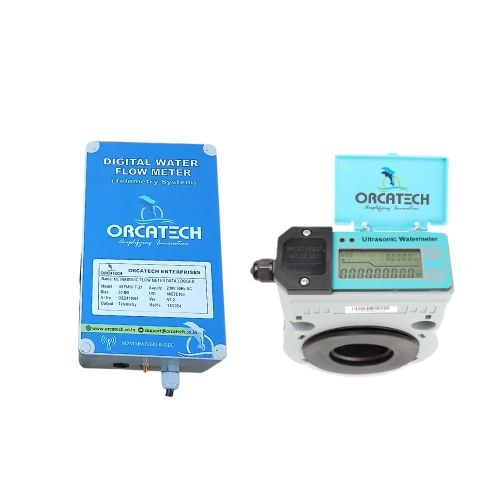 | Ultrasonic Flow Meter ₹45902 Telemetry Ultrasonic Flow Meter, Line Size: 50mm (2.0"), Flow Range 100 to 1000 LPM, Battery Operated Flowmeter, Data Logger Supply 220Vac, Flange... View product → |
 | Ultrasonic Flow Meter ₹47200 Telemetry Ultrasonic Flow Meter, Line Size: 65mm (2.5"), Flow Range 150 to 1500 LPM, Battery Operated Flowmeter, Data Logger Supply 220Vac, Flange... View product → |
Build a Purchase Checklist That Prevents Common Meter Failures
An order that names only pipe size and maximum flow leaves the main failure points undefined. Compare minimum, normal, and maximum flow, pressure, temperature, conductivity, solids content, pipe material, lining, and the required accuracy at each operating point.
Build a flow meter selection checklist that requires the supplier to confirm:
- Usable range and low-flow performance, not just rangeability or maximum flow.
- For a clamp-on ultrasonic meter: pipe outside diameter, wall thickness, liner, material, transducer spacing, signal diagnostics, and coupling compound.
- Liner and electrode materials against abrasives, chemicals, temperature, and conductivity. Specify options such as polyurethane, PTFE, EPDM, 316L, or Hastelloy only after checking the fluid chemistry.
- Maintenance access, cleaning requirements, replaceable parts, diagnostic alarms, enclosure rating, and the recalibration interval.
- Output type, protocol, totalizer units, data logging, power supply, and the response to signal loss or empty-pipe conditions.
| Failure source | Compare before ordering | Consequence of omission |
|---|---|---|
| Low conductivity | Actual µS/cm versus the meter’s minimum; 5 µS/cm is common | An electromagnetic meter may lose a stable signal |
| Abrasive solids | Liner hardness and thickness against grit or sludge | Premature liner wear |
| Poor installation data | Measured pipe and liner dimensions | Ultrasonic errors exceed catalogue accuracy |
| Formal accounting | OIML R 49 or ISO 4064 compliance and test records | The meter may fail acceptance |
For critical balances, write the acceptance test into the purchase order: factory certificate, witnessed comparison, and in-situ flow meter verification by calibrated reference meter, tank gravimetry, or certified prover.
Frequently asked questions
How should you define flow duty before choosing a meter size?
Record minimum, normal, and maximum flow, then select a meter that measures the full operating envelope rather than sizing it only to the pipe diameter or peak flow.
Which flow measurement principle suits industrial water?
Compare electromagnetic, ultrasonic, and mechanical meters against water conductivity, suspended solids, bubbles, pressure, accuracy requirements, and maintenance conditions.
What installation conditions must you check before approving a flow meter?
Confirm pipe filling, straight-run requirements, valve and pump locations, flow direction, access for maintenance, grounding, and the meter’s installation orientation.
What should a flow meter purchase specification include?
Specify the measuring range, accuracy, pipe size, lining and electrode materials, power supply, outputs, communications, verification method, records, and water-accounting requirements.