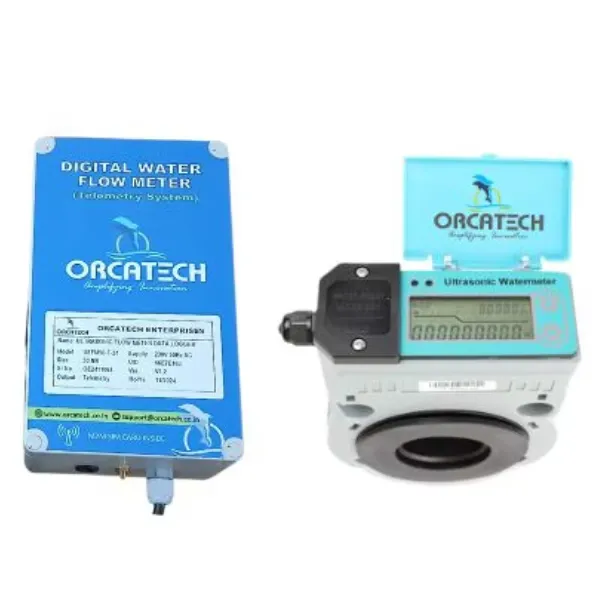
Measuring flow in an existing pipeline often raises a practical question: must the pipe be cut to install a meter? In many applications, the answer is no. A Clamp-On Ultrasonic Flow Meter uses externally mounted transducers to estimate liquid velocity through the pipe wall, allowing measurement without inserting a sensor into the flow stream.
This non-invasive arrangement can be valuable when shutdowns are difficult, contamination must be avoided, or a meter needs to be moved between measurement points. It is not automatically the best choice for every pipeline, so the application must be evaluated carefully.
How Clamp-On Ultrasonic Measurement Works
The transducers send ultrasonic signals through the pipe and flowing liquid. In a transit-time system, the instrument compares the travel time of signals moving with and against the direction of flow. The difference is used to calculate liquid velocity and volumetric flow.
Because the sensors remain outside the pipe, the system introduces no obstruction and causes no additional pressure loss. It also avoids direct contact between the instrument and the liquid.
Where It Offers a Clear Advantage
A clamp-on meter can be particularly useful for:
- Retrofitting established pipelines
- Temporary flow surveys
- Energy and water audits
- Pump-performance checks
- Cooling-water systems
- Treated-water networks
- Large-diameter pipes
- Processes where shutdown time is expensive
- Applications requiring hygienic separation
- Comparing flow across multiple locations
Industrial facilities in Pune may use portable units to investigate water balance, identify unexpected consumption, or verify the performance of existing meters. Permanently installed versions can support ongoing monitoring where pipe conditions are suitable.
Clamp-On Meter Compared with an Inline Meter
The main advantage of a clamp-on system is installation flexibility. An inline meter usually requires pipeline modification, process isolation, suitable flanges, and leak testing. External transducers can often be mounted while the process remains operational.
An inline meter, however, may provide more predictable performance in applications where the pipe and fluid conditions are well controlled. Its measuring section is defined by the manufacturer, while a clamp-on system depends heavily on the accuracy of field-entered pipe information and transducer installation.
The evaluation should consider:
- Required accuracy
- Installation downtime
- Pipe accessibility
- Pipe material and lining
- Fluid condition
- Available straight length
- Permanent or temporary use
- Maintenance access
- Total installation cost
The lower-disruption option is not necessarily the lowest-cost option if poor signal conditions prevent dependable measurement.
Conditions That Can Affect Performance
A Clamp-On Ultrasonic Flow Meter generally works best when the pipe is full and the liquid supports stable ultrasonic transmission. Excessive entrained air, heavy suspended solids, internal corrosion, thick linings, or uncertain wall thickness may weaken the signal.
Coating, scale, and rough external surfaces can also affect sensor coupling. Proper surface preparation and the correct coupling material are important.
Placement matters as well. Sensors should be positioned away from strong disturbances such as pumps, elbows, control valves, and partially filled sections. The manufacturer’s recommended upstream and downstream distances should be followed where possible.
Questions to Ask Before Selection
A technical supplier will normally need the following information:
- Pipe outside diameter and wall thickness
- Pipe and lining material
- Liquid type and temperature
- Expected flow range
- Available installation length
- Pipe orientation
- Required outputs and communications
- Power availability
- Desired portability
- Accuracy expectations
Photographs of the proposed location and information about nearby fittings can also improve the assessment.
Making the Investment Decision
Clamp-on technology is especially attractive when avoiding shutdowns, pipe cutting, leakage risk, or contamination is a priority. It can also support diagnostic work because a portable instrument can be relocated.
It is less suitable when pipe data is unknown, ultrasonic transmission is poor, or the line regularly runs partially full. A site assessment or preliminary signal test may be worthwhile before committing to a permanent installation.
For Pune-based industries and infrastructure projects, Orcatech Enterprises can evaluate pipeline information and intended use before recommending an ultrasonic configuration. Selecting the technology through application data helps ensure that the convenience of non-invasive installation is matched by dependable measurement performance.
Keywords